
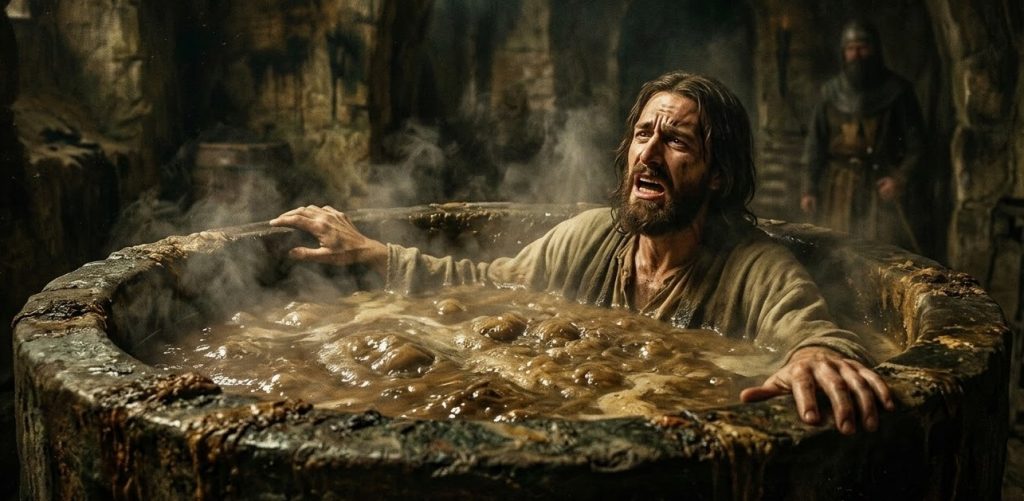
It’s a pretty intense and controversial passage, so I’ll break it down for you in plain English. Essentially, this part of the Talmud Gittin 57a describes a scene where a figure named “Yeshu” is being punished in the afterlife.
Here is a blogpost that covers what the text says and the context around it:
The Story
The passage follows a man named Onkelos (a famous convert to Judaism). Before he converted, he wanted to know if he should join the Jewish people. To find out, he used necromancy to summon the souls of three “enemies” of Israel to see how they were doing in the afterlife:
- Titus (The Roman general who destroyed the Temple).
- Balaam (A biblical figure who tried to curse Israel).
- Yeshu (Often identified as Jesus).
The “Jesus in Boiling Excrement” Part
When Onkelos speaks to Yeshu, he asks about his punishment. The text says:
He [Onkelos] asked: “What is your punishment?” He [Yeshu] replied: “In boiling excrement.”
The passage explains that this specific punishment is for those who “mocked the words of the Sages” (the Jewish rabbis and their teachings).
Is it actually Jesus?
This is where it gets tricky and debated by scholars:
- The Pro-Identity View: Many historians and critics point out that “Yeshu” is a common Rabbinic shorthand for Jesus of Nazareth. They argue the passage was written as a polemic (a harsh verbal attack) against Christianity during a time of high tension between the two religions.
- The Anti-Identity View: Many Jewish scholars argue that “Yeshu” was a common name at the time. They point out that the “Yeshu” in the Talmud often lived in time periods that don’t match the historical Jesus (sometimes 100 years before or after).
- The Censorship Factor: For centuries, these passages were actually removed from many printed versions of the Talmud because of Christian censorship and the fear of persecution. You’ll often find them now in “restored” versions or footnoted as Censored Expressions.
Sources to Study If You Want to Make your Own Research
If you want to look this up yourself, here are the references:
- Primary Source: Babylonian Talmud, Tractate Gittin, Folio 57a.
- Key Context: Look for the “Uncensored” or Schottenstein editions which usually provide notes on these “extra-canonical” sections.
- Historical Analysis: Peter Schäfer’s book, Jesus in the Talmud, is the go-to resource for a deep dive into why these stories were written and who they are actually about.
It’s definitely one of the “darker” corners of ancient religious debate, reflecting just how much friction existed between these groups nearly 2,000 years ago.