
Sweden Builds Nanobots to Clear Clogged Arteries
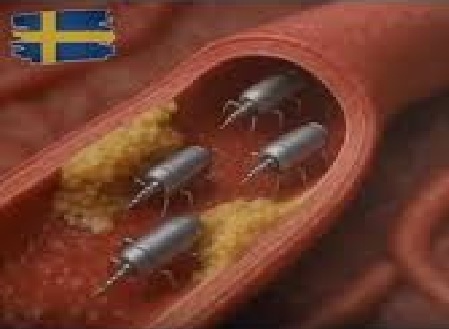
In a breakthrough that brings science fiction closer to the clinical reality of 2026, researchers in Sweden have unveiled microscopic nanobots designed to navigate the human circulatory system and dismantle arterial plaque. This technology offers a non-invasive alternative to traditional surgeries like angioplasty or stenting, potentially reversing the effects of atherosclerosis—the world’s leading cause of death.
The “Trojan Horse” of Cardiology
The nanobots, developed through a collaboration involving institutions like Karolinska Institutet, utilize a sophisticated “Trojan Horse” delivery system. Built using DNA origami—the art of folding DNA into specific 3D shapes—the bots are small enough to flow through the narrowest capillaries without triggering the body’s immune response.
Unlike previous treatments that rely on systemic medication, these nanodevices remain “locked” until they reach their specific target.
How the Precision Navigation Works
The system relies on a dual-mechanism for locating and destroying blockages:
- Magnetic Guidance: External magnetic fields are used to steer the nanobots through the complex “plumbing” of the human body. This allows doctors to concentrate the devices at the site of a known blockage, such as in the coronary arteries.
- Enzymatic Breakdown: Once the bots dock onto a plaque deposit, they deploy a “kill switch” activated by the specific pH levels or chemical signatures of the plaque.
- Specialized Payloads: The bots carry specialized enzymes and senolytic agents that dissolve hardened cholesterol and fibrous tissue, effectively “scrubbing” the artery wall from the inside out.
From Lab to Life-Saving Treatment
While earlier versions of this technology were tested in mice and pigs, recent data suggests these Swedish-developed bots have achieved a 20% to 50% reduction in plaque volume in advanced animal models. Crucially, the researchers noted that the bots do not cause “off-target” damage; once their task is complete, they are naturally filtered out by the liver or safely degraded by the body.
“We have managed to hide the weapon in such a way that it can only be exposed in the environment found in and around a blockage,” says the lead researcher. “This is precision medicine at the molecular scale.”
The team is currently preparing for the first phase of human clinical trials, which could begin as early as late 2026. If successful, this could transform heart disease from a chronic, life-threatening condition into one manageable via a simple infusion.